How to Facilitate a Coaching Circle Without Performing
Hot-seat, circle, case consult. Your job is the container, not the hero.


The tools got you a room. The 1:1-to-group post got you a curriculum idea. Neither taught you how to shut up so peers can do half the work. If you leave a circle as the smartest person in it, you performed.
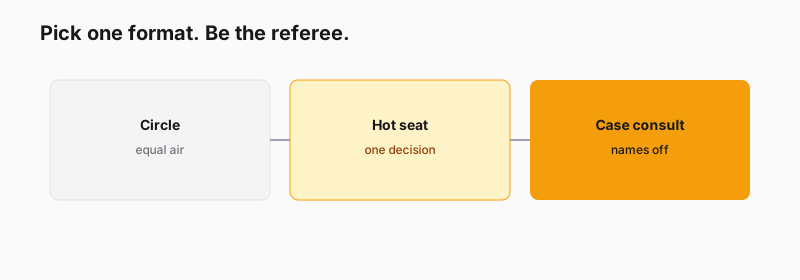
Start with the 10-minute open. Then pick a format on purpose. Do not run “a little of each” unless you like mush.
| Format | Who works | Best when | Your job |
|---|---|---|---|
| Circle | Everyone, same question, equal air | Building honesty, starting a cohort | Time, equal turns, no cross-talk |
| Hot seat | One client, group coaches | A live decision, a stuck experiment | Protect the seat, cut advice piles |
| Case consult | One coach (you or a member) brings a case | Training the group to think | Anonymize, scope, stop diagnosis |
Why Performing Fails
Performing looks like leadership. It trains a room of spectators. Spectators do not renew. They wait for your next monologue.
The fix: choose a format, publish the rules, and be the referee.
Circle
One question. Equal time. No fixing.
“What did you actually try, and what did it cost?”
Go in a visible order. When time is up, next person. If someone coaches out of turn, you interrupt: “That’s a gift. Hold it. Their minute.” You do not add the wise summary at the end unless you contracted a harvest.
Hot Seat
One person, one decision, a clock.
- Seat names the decision in one sentence (2 min).
- Group asks only clean questions — no “have you thought of” (8 min).
- Seat talks. Group is silent (5 min).
- Seat names the experiment. You write it (3 min).
If the group starts treating, you stop them. If the seat is in licensed-care territory, you refer — you do not let ten amateurs diagnose.
Case Consult
Someone brings a case with names off. The group thinks. You watch scope like a hawk. The point is the thinking, not a pile-on.
Never use a current 1:1 client as entertainment. If you cannot anonymize enough that they wouldn’t recognize themselves, you do not bring it.
Time Boxes
A 60-minute circle that tries two hot seats and a teaching is how you get none of them. One format per call. If you have 90 minutes, you may add a 10-minute harvest. You may not add a TED talk.
What Most Coaches Get Wrong
They rescue the quiet member by talking for them. They also let the overtalker “share more context.” Context is how circles become podcasts.
They switch formats mid-call because the energy dipped. The energy dipped because the rule wasn’t held. Hold the rule.
A 60-Minute Hot-Seat Rundown
- 0–10: arrival (pairs, contract).
- 10–12: seat names the decision.
- 12–20: clean questions only. You cut advice.
- 20–28: seat talks. Group silent.
- 28–32: experiment written.
- 32–35: you reset the room. No “quick add-ons.”
- 35–60: second seat, same bones — or a circle if the room is thin.
Two seats is plenty. Three seats is how the last person gets a leftover.
If someone is absent, do not narrate their work. The room is the people who showed up.
Language You Can Steal
Overtalker: “You’re at time. Hold the rest. Next.” Advice pile: “That was a suggestion. We’re in questions.” Rescue: “They get to finish. Your job is to listen.” Scope break: “We’re not going to treat this in the circle. I’m going to pause the seat.”
Say them early, once, as rules of the room — not as a scold after the third offense. New members hear the rules in week one. Returning members hear them again when they drift.
If you cannot interrupt, you cannot facilitate. Interrupting is the job. Being liked is not.
Close the call the way you close 1:1: one sentence of harvest, next date, stop. Do not take questions “real quick” at 59. That is how circles leak into unpaid office hours. The container includes the ending. End ugly and on time rather than generous and late. The ending is the product.
When DIY Isn’t Enough
When the room has no shared notes, no attendance, and no way to see who is disappearing, facilitation becomes detective work. Scale can hold the cohort rails. You still have to be the referee.
Want a group that holds itself when you stop performing? Let’s talk.