Feedback That Changes Behavior Without Bruising the Relationship
Observation, impact, request. When not to give advice. A table: advice / feedback / question.


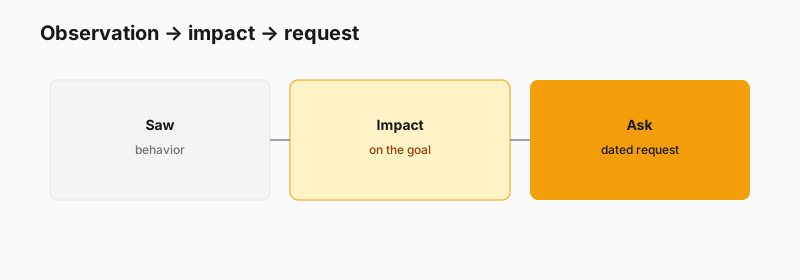
Advice is you in their chair. A question is them working. Feedback is the middle: what you saw, what it did, what you’re asking. Use it after a mid-session reset, not as a personality review. Progress gives you the observation. A testimonial is not feedback. The reminder is not either. The discovery hour is the wrong time to workshop their character.
| Move | Job | Example |
|---|---|---|
| Advice | You solve | “You should send it Friday.” |
| Feedback | You name an observation + ask | “You rewrote the send four times. It delayed the experiment. Will you send the current draft by Thursday?” |
| Question | They solve | “What would ‘sent’ cost you that ‘almost’ doesn’t?” |
Why Advice Bruises
It makes them a student. Students nod and don’t change. Then you both pretend the hour worked.
The fix: observation → impact → request. No adjective about their soul.
The Script
“Here’s what I saw: [behavior]. Here’s the impact on [the goal]: [result]. I’m asking [specific request]. Yes or a better request?”
If they pick a better request, take it. If they defend, don’t pile on. Ask one question. Then wait.
When Not to Give Feedback
- You are annoyed. That’s your supervision, not their hour.
- You have no observation, only a theory.
- They already named it. Then you ask, you don’t re-announce.
If the observation is “you seem anxious,” you put a word in their mouth. Don’t. See clean language later this month.
What Most Coaches Get Wrong
They sandwich feedback in praise so nobody feels anything. Then nothing changes.
They also give feedback about identity (“you’re a procrastinator”) instead of a dated behavior. Identity feedback is a bruise with no lever.
They send feedback by text after 7pm. That’s a comms miss and a coward’s delay. Say it in the hour.
A Worked Turn
They skipped the send again. Observation: “The draft is in the folder. It didn’t leave.” Impact: “The 90-day outcome needs two live conversations. We have zero.” Request: “Send the current version to two people by Thursday 4pm. I’ll ask for the sent folder.”
No speech about fear. If fear is the work, that’s a question, not a lecture.
Feedback vs the Other Two
If you hear yourself listing options, you slipped into advice. Stop. Pick one observation or ask one question.
If you hear yourself asking a question you already know the answer to so you can look Socratic, that’s advice in a costume. Say the observation.
Practice the script once with a peer. Have them stop you when an adjective about character appears. Those adjectives are the bruise.
After They Say Yes to the Request
Write the request as the experiment. Review it next time as data, not as obedience. If they mutate it into something better, take the mutation. Feedback is not a power play.
Two More Worked Turns
Skipped homework: “You said Thursday. Thursday passed. The 90-day outcome needs the send. I’m asking you to send the current draft before we meet Tuesday, or we use Tuesday to decide if this engagement still has a job.”
Overtalk in group: “You went three minutes over. Two other people lost a turn. Next call I’m cutting at two. I want you in the room — inside the time.”
Both are observations + impact + request. Neither is a character study. If your chest is hot when you say them, take it to supervision first. Hot feedback is you, not them.
Write the request in the recap so it cannot dissolve. Feedback that lives only in the air will be rewritten by both of you by Thursday. The written request is the kindness.
If they say the request is too small, shrink it anyway until Tuesday is obvious. Feedback that asks for a personality transplant will be nodded at and ignored. Behavior that fits a calendar is the only kind that changes. If you leave the hour without a written request, you gave a speech. Speeches do not change Tuesdays. End the feedback turn by writing the request where they can see it. If they flinch, shrink it in the room. A smaller request they own beats a brave one they perform.
When DIY Isn’t Enough
Feedback fails when you cannot remember the last experiment. Notes and recaps are the memory. Grow / Scale can surface the last request at the top of the session card. You still have to say the sentence.
Want the last experiment on the session card so feedback has a fact? Let’s talk.