The Client Progress System That Makes Outcomes Visible
Client-facing recaps, a 4-session review ritual, and when the numbers lie. Not another sticky-notes rant.


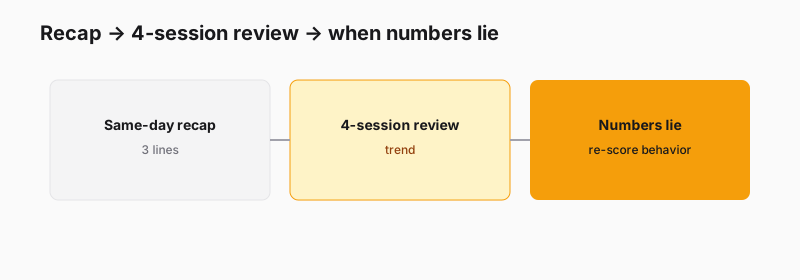
How to track client progress already owns the three data points: insight, actions, score. Keep them. This post is what you do with them in front of the client — the recap they can forward, the 4-session review, and when the number is lying. I will not retell the sticky-notes-versus-spreadsheet story. You already know that system dies.
If the three points live only in your notebook, you have a diary. Diaries do not renew. Visible progress does.
The portal and Notion are surfaces. The ritual is the product. After a fall reset, this is how you prove the new sentence is moving. In a breakout, the harvest line can be the week’s score.
| Cadence | Who sees it | Job |
|---|---|---|
| Same-day recap | Client | Contract, experiment, score — one screen |
| 4-session review | Both | Trend, not vibes |
| When numbers lie | Both | Change the question, not the font |
The Same-Day Recap
Three lines, same day, where they already look (email or portal). Not a transcript.
Today’s contract: [sentence] Experiment: [what / when / how we’ll know] Score: [n]/10 on [the actual goal]
If you cannot write it in two minutes, the hour did not produce an artifact. Fix the hour. Do not write a prettier recap.
Send it even when the score dropped. Especially then. Hidden drops are how week 3 goes quiet.
The 4-Session Review
Every fourth session, the first 12 minutes are a review. Not a vibe check. A table.
- Last four scores, spoken out loud.
- Last four experiments: done / skipped / mutated.
- One pattern you both see.
- Keep / reshape the goal (one sentence).
- Next four-session contract.
Write it on the shared page. If the trend is flat, the honest question is “are we in the right engagement?” not “how can I be more supportive?”
Do this on a calendar. If you wait until they “feel ready,” you will do it never.
When the Numbers Lie
A 9/10 with no behavior change is a people-pleasing score. A 3/10 after they finally sent the thing may be honesty, not failure.
Rules:
- The score is about the contracted goal, not their week.
- If they cannot name the behavior behind the number, throw the number out and re-score on the behavior.
- Three flat 7s are not stability. They are a goal that is too vague to move.
When the number lies, change the question: “What did you do toward Wednesday-at-8?” Then score that.
Do not add a fourth metric to rescue a vague third. The original post already named mood as optional. This ritual uses the three you have.
A Worked Month
Session 1: contract “two live conversations.” Score 3. Experiment: send two notes. Session 2: sent one. Score 4. Experiment: send the second plus one ask. Session 3: both sent, one reply. Score 6. Experiment: book the call. Session 4: review. Scores 3-4-6. Pattern: sending is live; booking is the new contract. Reshape. Score today’s booking goal: 2.
You did not need a dashboard product. You needed four recaps and twelve minutes.
What Most Coaches Get Wrong
They share a screenshot of a spreadsheet the client cannot read. Visible means their sentence + one number, not your system.
They also skip recaps when the hour was messy. Messy hours are why recaps exist.
They run the 4-session review as a pep talk. Pep talks do not change the next experiment.
Notes You Keep vs Notes They Get
You may keep a private line: “I think they’re about to ghost.” They get the recap, not your anxiety. If the anxiety is a pattern, it belongs in the review as a question: “I’m noticing the thread got thin. What’s true?”
Do not paste private supervision notes into the portal. That’s how trust dies.
Training the Client to Look
Tell them in session 1: “You will get three lines after every hour. If you don’t, ping me. If you don’t read them, we will notice.” Then send them. Consistency is the system. The tool is a tray.
If they never open the recap, ask once. If they still don’t, the engagement is already optional for them. Name it.
A Recap They Can Forward
Subject: “Tue session — contract, experiment, score”
Body:
- Contract: two live conversations this month
- Experiment: send current draft to Sam and Priya by Thu 4pm
- Score: 4/10 on live conversations (was 3)
That’s the whole email. If a spouse or a business partner reads it, they should understand the engagement. If they wouldn’t, you wrote a diary.
Do not attach a PDF. Do not say “as we discussed.” The three lines are what you discussed.
Running Reviews Without a Retreat
Batch 4-session reviews on one Friday if you must. Twelve minutes each. Scores already in the recaps. You are not rediscovering the month. You are reading a table out loud and asking for a verdict.
If four clients are flat, that’s your supervision case, not a reason to skip the ritual.
Clients who refuse the review are telling you the engagement is optional. Believe them.
Building the Shared Page
One page per client. Not a new app.
Top: the current goal sentence and today’s score. Middle: a running list of recaps (date, experiment, score). Bottom: the last 4-session verdict.
That’s enough to run the ritual. If you are already in Notion, this is one database view, not a rebuild. If you are in Google Docs, it is one doc with a table. If you are on a portal, it is the session list the client can already see.
Do not color-code. Do not add sparkline vanity. The sentence + the number is the product.
Review the page yourself for 60 seconds before the 4-session hour. If you cannot see the trend without scrolling, the page failed. Cut old recaps into an archive. The ritual uses four, not forty.
What You Say When the Score Drops
“Last time was a 6. Today is a 3. What did we learn, and does the goal still earn the next four sessions?”
No cheerleading. No “but you’re doing great.” If the drop is honesty, honor it. If the drop is a people-please reversal, ask for the behavior behind the old 6.
Then reshape or complete. A dropped score that you soothe into a 5 is how you buy another month of fog.
Objections You’ll Hear
“I hate numbers.” Then we score a behavior: sent / not sent. That’s still a number. Words without a mark will not survive October.
“Can we skip the recap this week?” Once. The second skip is data. Name it.
“I already know how I’m doing.” Good. Then the recap takes 20 seconds to confirm. People who “already know” are often protecting a story. The page is how we check the story against Tuesday.
“This feels corporate.” Corporate is a 12-tab CRM. Three lines is respect. If they wanted fog, they should not have hired a coach.
Hold the ritual anyway. The coaches who drop it are the ones who cannot show movement at renewal.
The ritual is the offer. If they hired you to “explore,” you still need a mark. Exploration without a score is how September becomes October with the same sentence. Put the next review date on the calendar before they leave. Dates are how rituals survive moods.
The Review Script (Twelve Minutes)
Minute 0–2: scores out loud. No commentary yet. Minute 2–5: experiments — done, skipped, mutated. Minute 5–8: one pattern. If you name three, you named none. Minute 8–10: keep or reshape the sentence. Minute 10–12: next review date on the calendar.
If you routinely blow twelve, you turned a review into a session. Book a session. The ritual is a table.
Clients who cry in the review are allowed. Crying is not a reason to drop the number. Finish the verdict, then coach.
What Visible Is Not
Visible is not a public leaderboard. Visible is not a screenshot of your CRM. Visible is not a monthly PDF they will not open.
Visible is: they can say the sentence, the last score, and the next experiment without looking at you. If they cannot, the system is still private. Fix the recap, not the branding.
At renewal you will want a slide. Don’t. Open the shared page. Read the last four scores. Ask: “Does this earn another container?” That is the evidence. The renewal sequence owns the week-10 timing. This page is what you point at.
When DIY Isn’t Enough
When you have more than a dozen active clients and recaps slip, you do not need a new philosophy. You need the three fields on the session record so sending is a button. Grow and Scale can hold that. You still have to run the 4-session review with your mouth.
Want progress both of you can point at without a spreadsheet sermon? Let’s talk.